
News
Europe's fossil CO₂ inventory: a bridge, not an endpoint
Europe still emits ~1 GtCO₂/year from large point sources — in theory enough for 727 Mt of methanol. But hydrogen, certification and the 2036/2041 eligibility windows shrink the real potential dramatically.
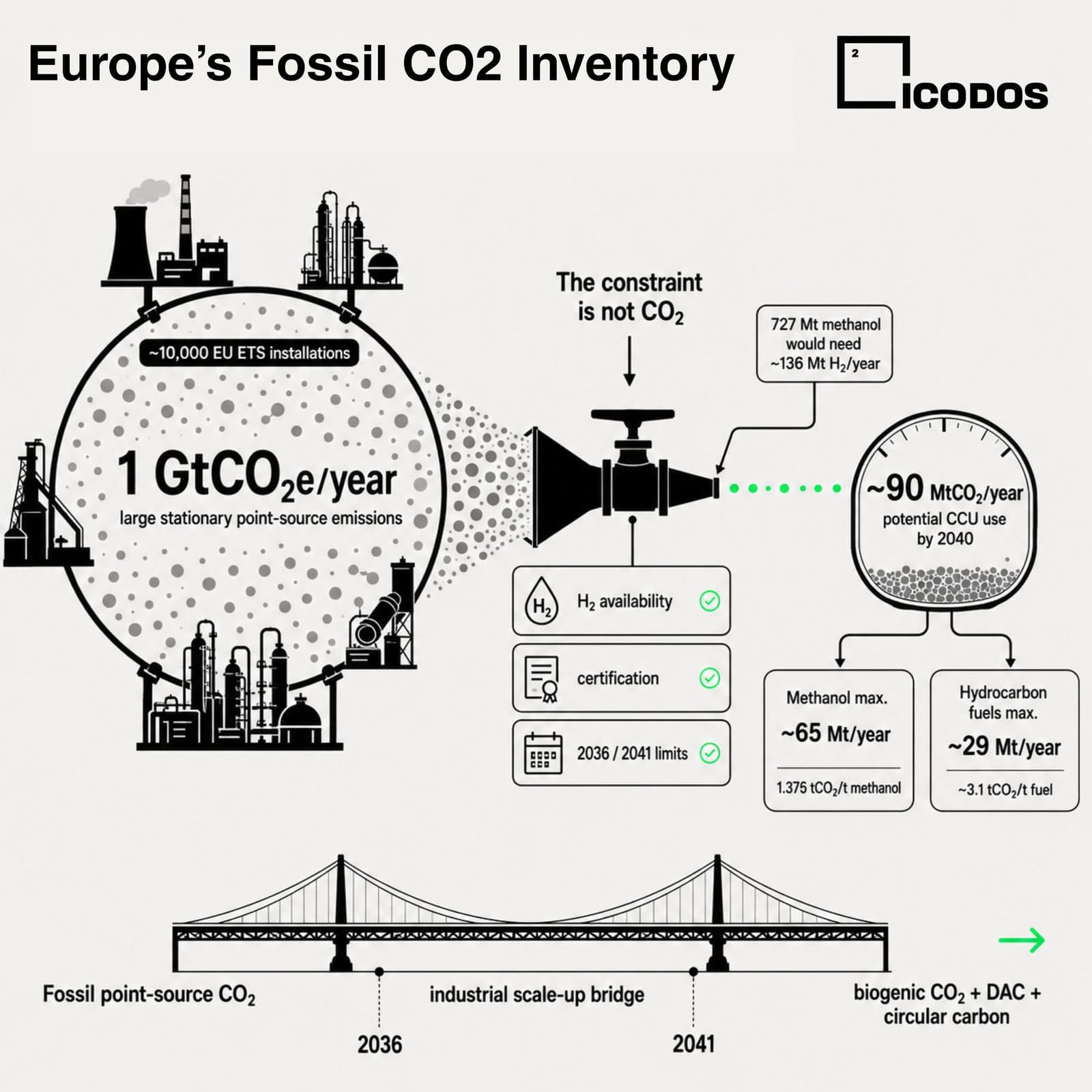
Europe still emits about 1 GtCO₂ per year from large stationary point sources. That sounds like an almost unlimited carbon source for e-fuels. It is not.
The physical pool
The EU ETS covers roughly 10,000 large installations in energy and manufacturing: power plants, refineries, steel, cement and lime, chemicals, pulp and paper, glass, ceramics and metals. Together, these stationary sources still emit around 1 GtCO₂e per year — even after a 51% reduction since 2005. If all of that CO₂ were converted into fuels, the theoretical numbers are huge: about 727 Mt of methanol per year (1 tonne of methanol needs ~1.375 tonnes of CO₂), or about 320 Mt of hydrocarbon fuels (at ~3.1 tonnes of CO₂ per tonne of fuel). But this is the wrong way to think about the market.
The real constraint
CO₂ is not the only input. 727 Mt per year of methanol would need roughly 136 Mt per year of hydrogen before losses — which means enormous amounts of renewable power, electrolysers, water, synthesis capacity, certification, permits, offtake and capital. The harder question is not "is there enough CO₂?" It is: how much CO₂ is usable, certifiable, close to hydrogen, and still eligible under the rules?
The policy window
EU rules make fossil point-source CO₂ a bridge, not an endpoint. Captured fossil CO₂ can count in the fuel's GHG calculation only temporarily: until 2036 for CO₂ from fossil electricity generation, and until 2041 for other eligible industrial CO₂ if covered by an effective carbon price. After that, the carbon source has to move toward biogenic CO₂, direct air capture, or other eligible circular carbon. Fossil point-source CO₂ can help Europe build its first industrial e-fuel assets — proving plants, customers, certification, financing and supply chains — but it should not be the long-term foundation.
The practical potential
The European Commission expects around 280 MtCO₂ per year to be captured by 2040, of which up to one third could be used — about 90 MtCO₂ per year for all CCU applications: fuels, chemicals, polymers, minerals and other uses. If all of it went into methanol, that would be ~65 Mt per year; into hydrocarbon fuels, ~29 Mt. In reality it will be split across many uses, and storage will compete for the same CO₂. The practical conclusion: there is enough fossil point-source CO₂ to launch the European e-fuel industry — but not enough policy-stable fossil CO₂ to build the final system around it. The best projects will use the bridge without becoming dependent on it.