
News
EU Commissioner Jessika Roswall visits ICODOS' Mannheim 001 plant
The EU Commissioner for Environment, Water Resilience and a Competitive Circular Economy toured the world's first e-methanol plant powered by wastewater CO₂, together with Baden-Württemberg's Environment Minister Thekla Walker.
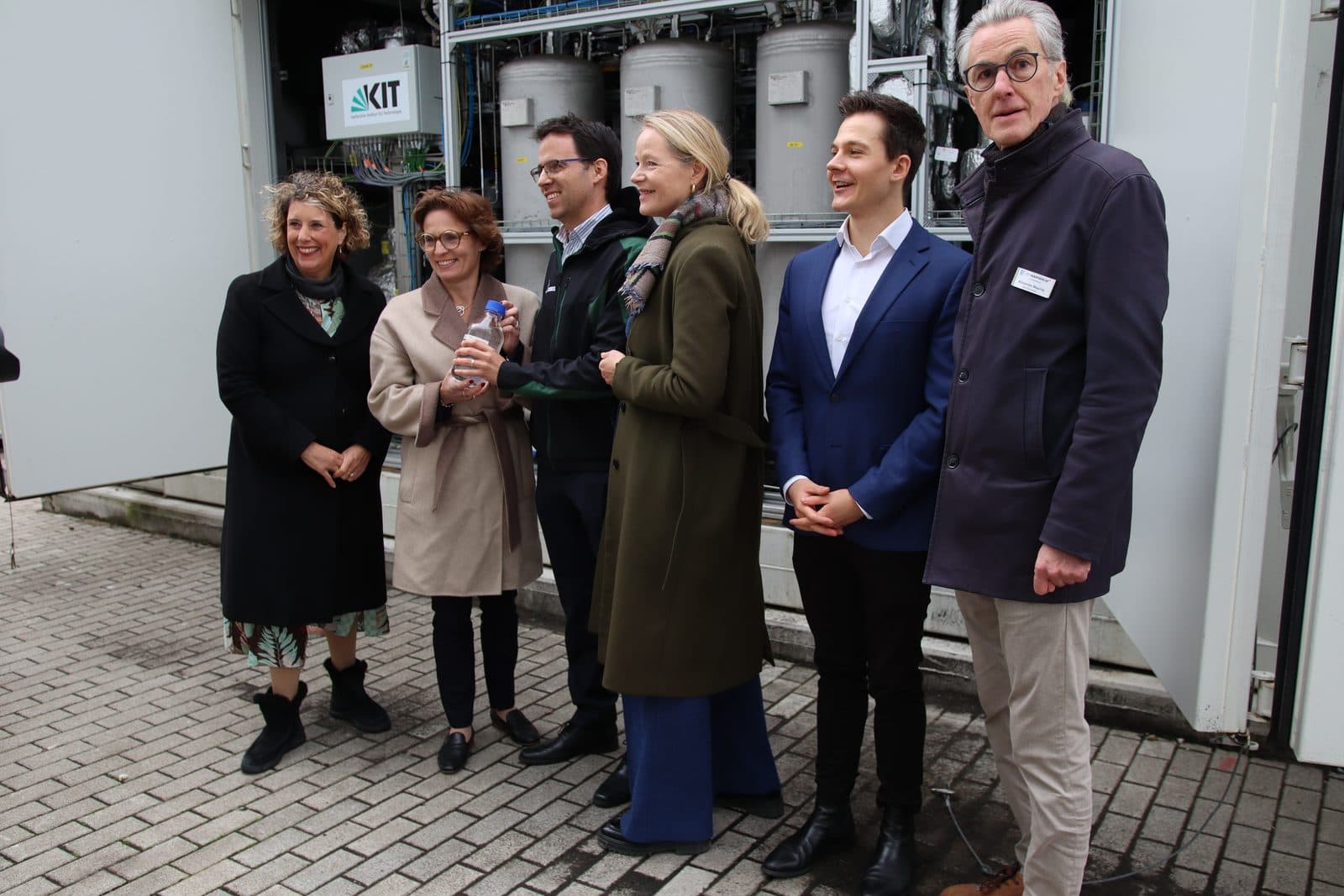
Mannheim, 7 October 2025 — ICODOS welcomed high-level European visitors on Monday: Jessika Roswall, EU Commissioner for Environment, Water Resilience and a Competitive Circular Economy, toured the Mannheim wastewater treatment plant — home of ICODOS' Mannheim 001, the world's first plant producing e-methanol from wastewater CO₂.
The Commissioner was accompanied by Baden-Württemberg's Environment Minister Thekla Walker and welcomed by Mannheim's First Mayor Prof. Dr. Diana Pretzell and plant manager Alexander Mauritz. For ICODOS, managing directors David Strittmatter and Francisco Vidal Vazquez together with Mannheim 001 project lead Christian Wünsch presented the technology and guided the delegation through the plant.
Climate-neutral shipping fuel from wastewater
At Mannheim 001, ICODOS captures CO₂ from the sewage gas produced on site and converts it, together with green hydrogen, into e-methanol — a climate-neutral fuel for shipping and a renewable feedstock for the chemical industry. The demonstration plant shows how Europe's roughly 80,000 wastewater treatment plants could become decentralised production sites for renewable fuels.
A site where Europe's water policy becomes visible
The visit also highlighted the Mannheim site's pioneering role in water treatment: the plant, which treats an average of 81,000 cubic metres of wastewater per day, was the first in the world to implement a fourth treatment stage using powdered activated carbon at industrial scale — a technology the EU has decided to make mandatory, with transposition into national law due by mid-2027.
The visit of Commissioner Roswall underlines the European relevance of the questions being answered in Mannheim: how existing infrastructure can be turned into a source of circular, climate-neutral molecules — and how European regulation and European innovation can reinforce each other.